
LLM connections can currently be used in Document Skills through ABBYY Advanced Designer only. Connections are managed at the tenant level and are available to all skill designers in your organization.
Prerequisites
Before you begin, make sure you have the following.- Administrator access to ABBYY Vantage Configuration.
- An active subscription with your chosen LLM provider, or an OpenAI-compatible endpoint you host or control.
- Connection details for that provider or endpoint:
- Anthropic - API key from your Anthropic account.
- Google AI Studio - API key from your Google AI Studio account.
- Microsoft Foundry - Azure API key, the complete endpoint URL (including the
/chat/completionspath and API version), and the deployed model name from Azure. - Mistral AI - API key from your Mistral AI account.
- OpenAI - API key from your OpenAI account.
- Custom (OpenAI-Compatible) - API key, the base URL of your endpoint, and the model name your endpoint serves. The endpoint must be reachable from your ABBYY Vantage deployment.
These prerequisites apply to connections you configure yourself. The ABBYY Phoenix Model connection requires none of them: ABBYY provides the subscription and the credentials. See ABBYY-managed connections.
Add an LLM connection
1
Open the Connections page
In the left sidebar, under ADMIN, click Configuration (gear icon), and then click Connections.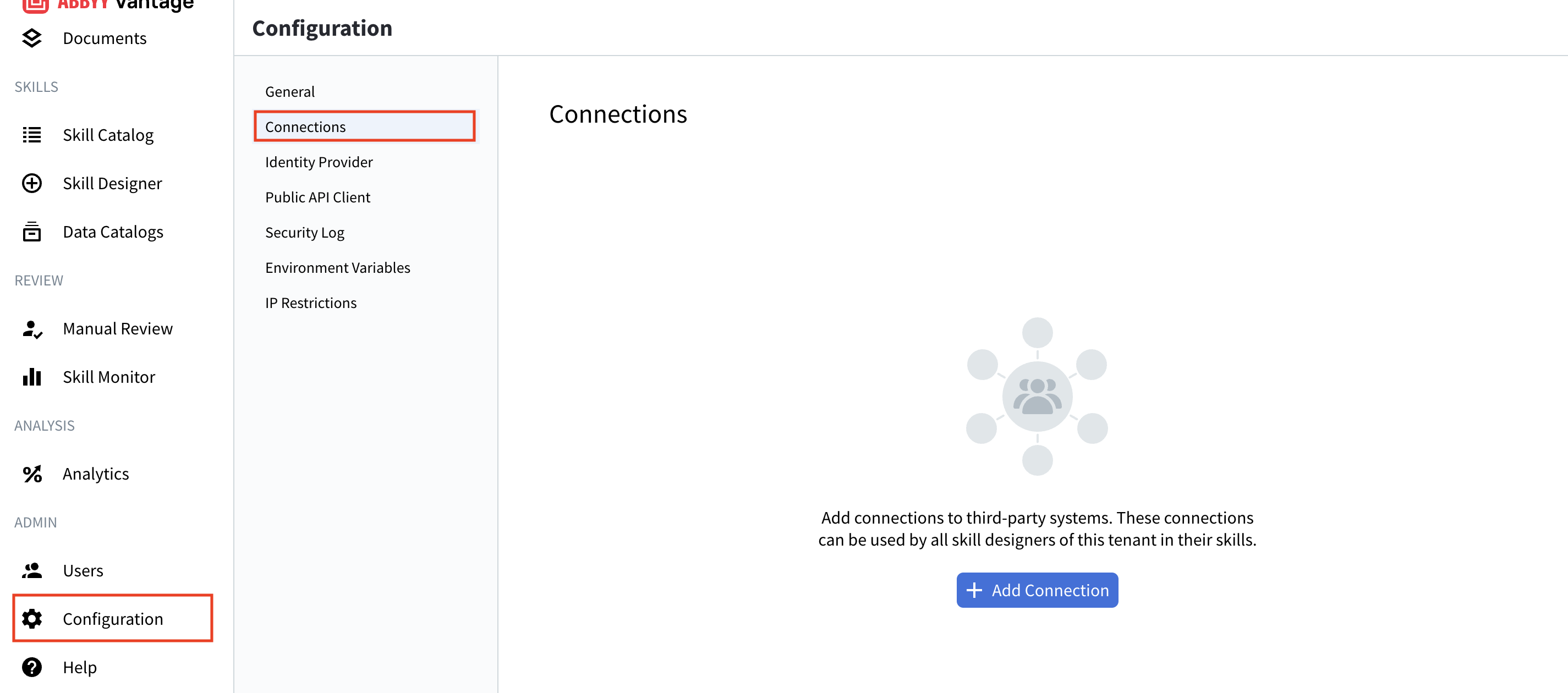
2
Select a provider
Click + Add Connection. The Add Connection dialog lists the available providers: Anthropic, Microsoft Foundry, Google AI Studio, Mistral AI, OpenAI, and Custom (OpenAI-Compatible).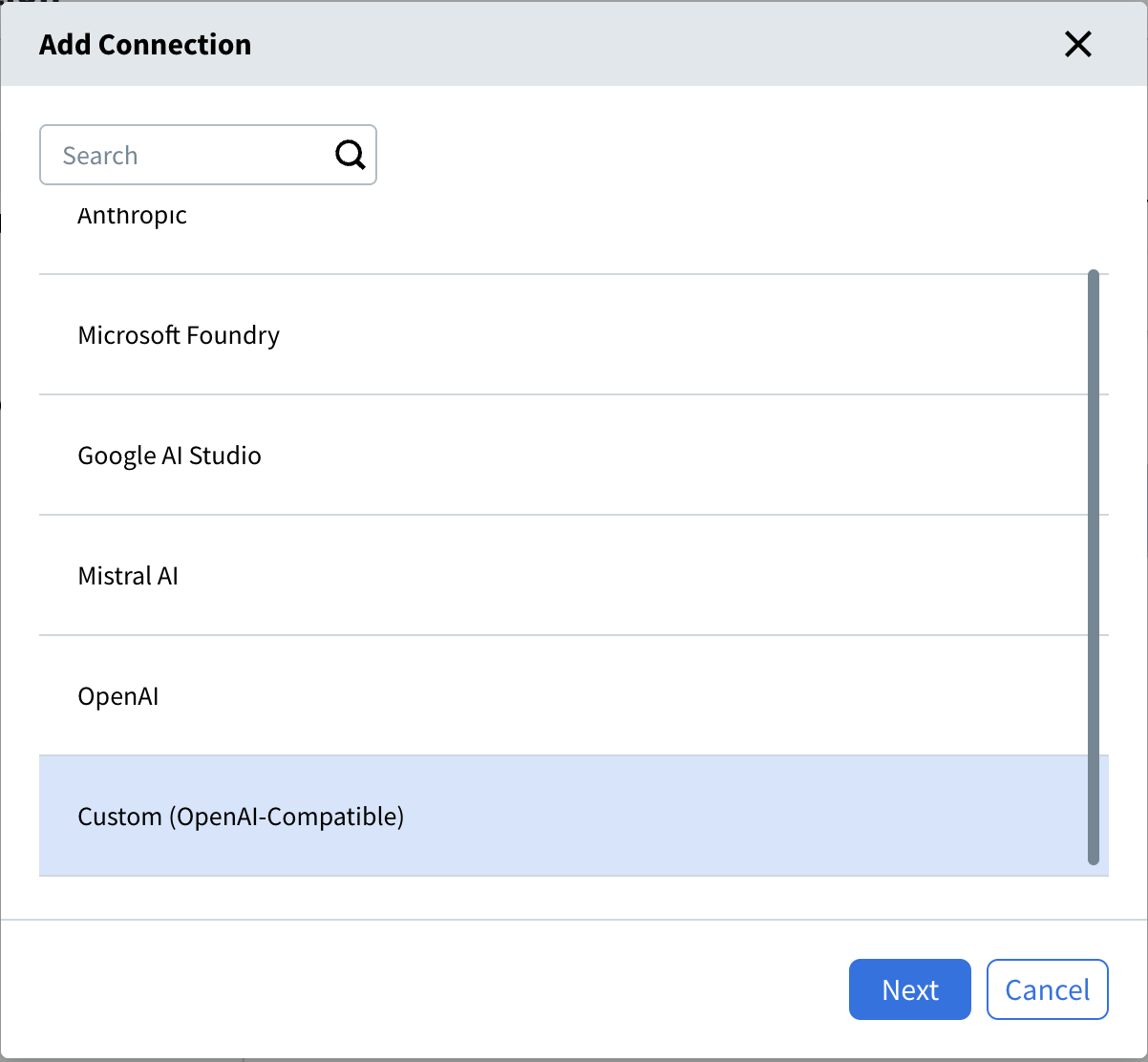
3
Enter the general settings
Give the connection a name and an optional description.
- Name - A unique name for the connection. This name appears when skill designers select a connection in a Document Skill, so choose something descriptive, such as
Production ClaudeorMistral AI. - Description - Optional context about the connection’s purpose or environment. Don’t include API keys or other credentials.
4
Enter the connection settings
Enter the credentials for your provider. The required fields depend on the provider you selected. For the fields per provider, see Connection settings by provider.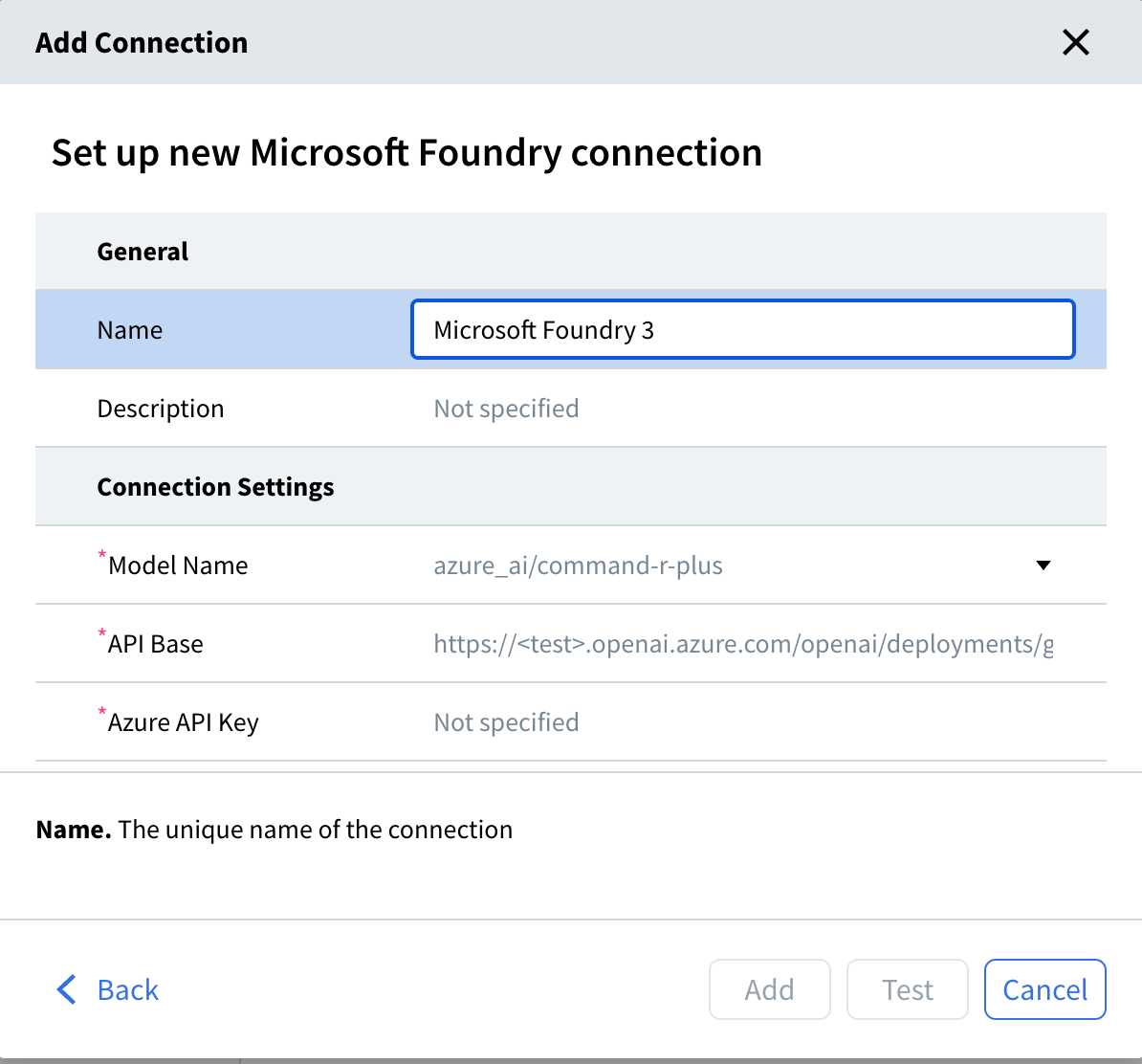
5
Test the connection
Click Test. Vantage attempts to reach the provider with the credentials you entered.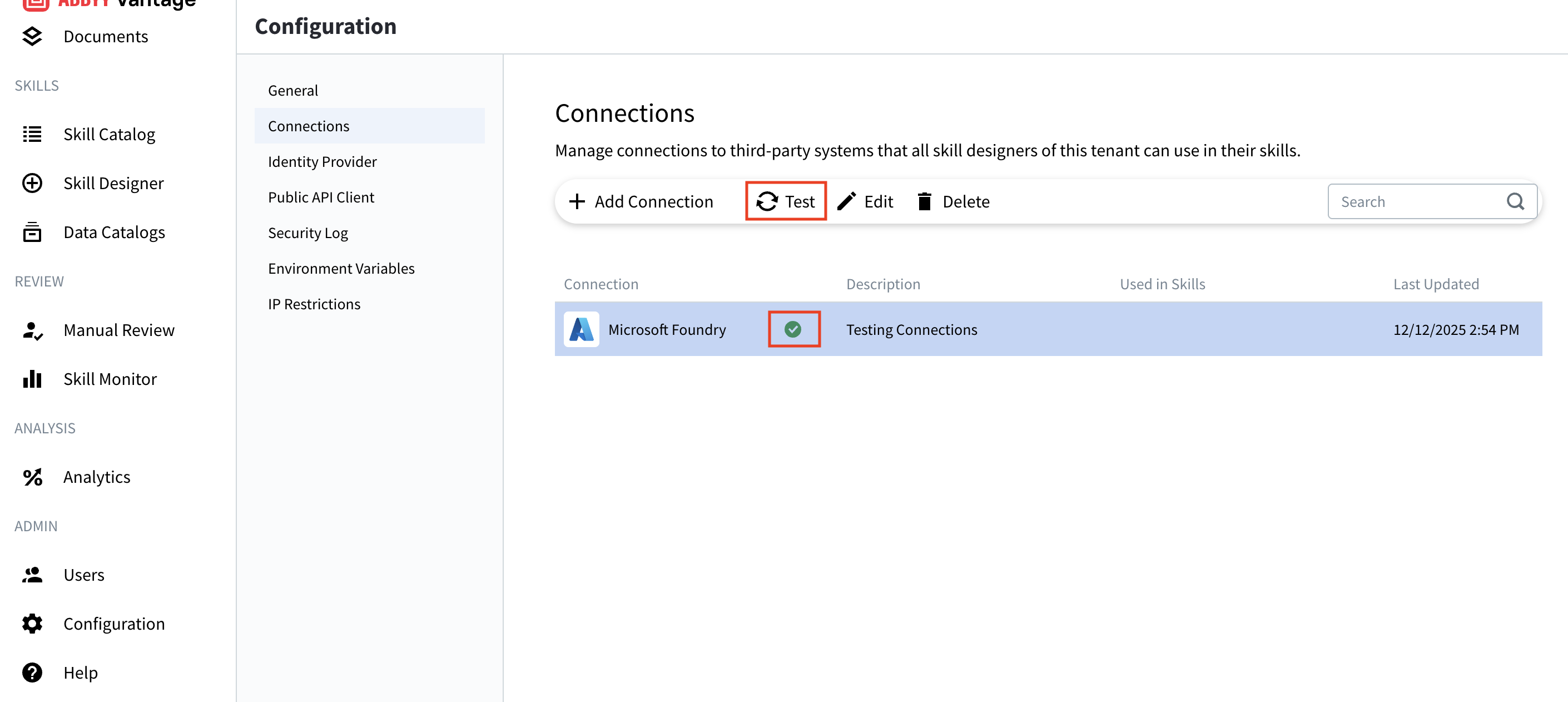
6
Save the connection
After the test succeeds, click Add. The connection appears in the Connections list and is immediately available to all skill designers in your tenant.
After a skill that references this connection is published, the connection becomes the default in the Vantage Web Portal, under Skill Catalog → [skill] → Parameters. A tenant administrator can override the default per environment without republishing the skill. For more information, see Document skill parameters.
Connection settings by provider
The Connection Settings fields differ by provider. Enter the exact model name your account supports. For example models, see Supported LLM providers and models.Anthropic
- Model Name - The Anthropic model to use. Select the model your account supports.
- API Key - Your Anthropic API key (starts with
sk-).
- Upstream API Base - A base URL to send requests to instead of Anthropic’s default,
https://api.anthropic.com.
Google AI Studio (Gemini)
- Model Name - The Gemini model to use, for example
gemini-2.0-flash. - API Key - Your Google AI Studio API key, from Google AI Studio → Get API key.
- API Base - A base URL to send requests to instead of Google’s default,
https://generativelanguage.googleapis.com/v1beta.
Microsoft Foundry
- Model Name - The name of your deployed model in Microsoft Foundry, from Azure Portal → your Microsoft Foundry resource → Deployments. Enter the bare deployment name, matching the deployment exactly.
- API Base - Your Microsoft Foundry endpoint, from Azure Portal → your Microsoft Foundry resource → Keys and Endpoint. Include the deployment path and API version, for example
https://<resource>.cognitiveservices.azure.com/openai/deployments/<model-name>/chat/completions?api-version=2025-01-01-preview. - Azure API Key - Your Microsoft Foundry API key, from the same Keys and Endpoint page.
The Model Name dropdown lists a generic model catalog rather than your own Azure deployments, so it can offer models you have not deployed. Ignore the list and type your deployment name. The placeholder text shows a prefixed form such as
azure_ai/command-r-plus; do not include a prefix.Mistral AI
- Model Name - The Mistral AI model to use. Select the model your account supports.
- API Key - Your Mistral AI API key.
OpenAI
- Model Name - The OpenAI model to use, for example
gpt-5.6. - OpenAI API Key - Your OpenAI API key (starts with
sk-), from OpenAI Platform → API Keys.
- API Base - A base URL to send requests to instead of OpenAI’s default,
https://api.openai.com/v1. - OpenAI Organization ID - The OpenAI organization to attribute the usage to, from your OpenAI organization settings. Set this only if your account belongs to more than one organization.
Custom (OpenAI-Compatible)
Use this option for an endpoint you host or control that implements the OpenAI chat completions API.- Model Name - The model your endpoint serves, for example
mistral-large-2411. Vantage does not suggest models for this option, so type the name exactly as your endpoint exposes it. - API Base - The base URL of your endpoint, for example
https://my-llm.example.com/v1. Enter an absolutehttporhttpsURL. - API Key - The key your endpoint accepts. Vantage sends it as a bearer token.
http or https URL, and rejects the connection otherwise. It does not check the address itself when you save. An endpoint your Vantage deployment cannot reach saves without error and fails when you click Test.
ABBYY-managed connections
Not every connection in the list is one you created. If your tenant has the ABBYY Phoenix Plus entitlement, a connection named ABBYY Phoenix Model appears alongside your own, shown with a padlock icon and the description Managed by ABBYY. Provides access to the ABBYY Phoenix model. ABBYY provisions it automatically when the entitlement is enabled, and it uses credentials ABBYY owns and operates. There is nothing to configure: no API key, no endpoint URL, and no model name. For what ABBYY Phoenix Plus is and how to obtain it, see LLMs in ABBYY Vantage.
The connection exists for as long as the entitlement does. If ABBYY Phoenix Plus is turned off for your tenant, the connection is removed and any skill still pointing at it stops working. Your ABBYY account team manages the entitlement, so this should not arrive unannounced, but it is worth knowing when you build a skill around it.
Usage of the ABBYY Phoenix Model connection is metered by ABBYY against your entitlement. It is not billed by an external provider, so it does not appear in any provider dashboard. For consumption figures, contact your ABBYY account team.
Manage connections
Connections are shared, so a change affects every skill that uses them. Test after any change.Edit a connection
1
Select the connection
On the Connections page, select the connection, and then click Edit (pencil icon).
2
Update and test
Update the fields, click Test to confirm the connection still works, and then click Save.
An ABBYY-managed connection cannot be edited. Edit is disabled for it, with the tooltip “This connection is managed by ABBYY and cannot be edited or deleted”, and the change is refused if attempted through the API. See ABBYY-managed connections.
Test a connection
On the Connections page, select the connection, and then click Test (refresh icon) to verify the credentials still work. This is useful for routine checks and troubleshooting.Delete a connection
On the Connections page, select the connection, click Delete (trash icon), and then confirm. You can’t delete a connection that is used in an active skill. Remove the connection from all skills first.An ABBYY-managed connection cannot be deleted. It is removed automatically if the entitlement behind it is turned off.
Troubleshooting
The connection test fails
Check the credentials and settings for the provider.- Invalid API key - Confirm you copied the entire key, with no extra spaces. Regenerate the key in the provider’s portal if needed.
- Invalid endpoint URL - For Microsoft Foundry, confirm the API Base is complete, matches your Azure resource, and has no typos in the deployment path. For Custom (OpenAI-Compatible), confirm the API Base is absolute, uses
httporhttps, and is reachable from your ABBYY Vantage deployment. - Wrong model name - Confirm the model or deployment exists and is active, and check spelling and capitalization (case-sensitive).
- Network issues - Confirm outbound HTTPS is allowed and your Vantage instance can reach the provider.
- Quota or permissions - Confirm your subscription is active, you’re within rate limits, and the key has the necessary permissions.
The connection works in the test but fails in a skill
- Refresh the Skill Designer page, and re-select the connection in the skill.
- Confirm the skill is published, not in draft.
- Check the skill’s error logs for specific messages.
Edit and Delete are greyed out for a connection
Hovering over Edit or Delete shows “This connection is managed by ABBYY and cannot be edited or deleted”. ABBYY owns the credentials behind that connection, so it is read-only to your tenant. Test still works, and the connection can be selected in skills normally. See ABBYY-managed connections.The ABBYY Phoenix Model connection is no longer listed
The connection exists only while your tenant holds the ABBYY Phoenix Plus entitlement. If it has disappeared, the entitlement is no longer active, and skills that used it will fail on their next run. Contact your ABBYY account team.API costs are higher than expected
- Review which skills use the connection, and their processing volume.
- Use smaller, faster models for simple tasks.
- Monitor usage and set budget alerts in your provider’s dashboard.
- Usage of the ABBYY Phoenix Model connection does not appear in any provider dashboard, because it is metered by ABBYY rather than billed by a provider. Contact your account team for those figures.
Best practices
- Secure your credentials. Never share API keys or put them in a description. Rotate keys regularly, grant each key the least privilege it needs, and use separate connections for development and production.
- Name connections clearly. Use names that indicate purpose or environment, such as
Production GPT-5.6orDevelopment Foundry, rather thanConnection 1. Record the environment, use case, and owner in the description. - Review connections regularly. Test connections on a schedule and after any credential change, and use the Used in Skills column to find and remove connections no longer in use.
- Manage cost. Use smaller, faster models for simple tasks, keep prompts efficient, and set budget alerts in your provider’s dashboard.
Additional resources
- Anthropic API documentation
- Google AI Studio
- Microsoft Foundry
- Mistral AI documentation
- OpenAI API documentation